
Buried Beauty
The Apothecary Journal
A formulation chemist explained it to me off the record, in a hotel lobby in Chicago. Then she asked me not to use her last name.
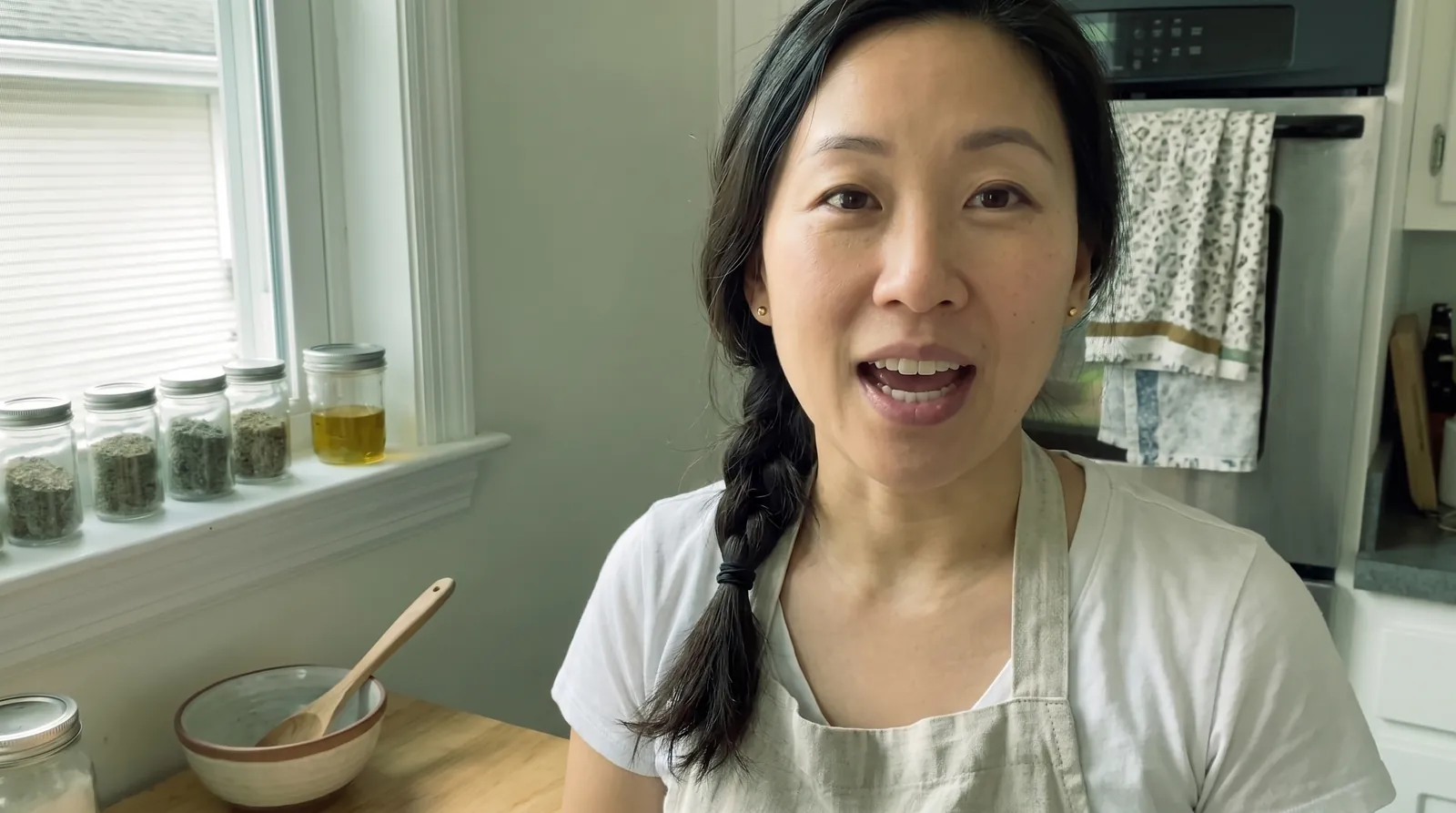
I used to carry my own hair to the trash in a closed fist.
Not a few strands. A handful — every single shower — pulled off the drain cover and squeezed shut on the way to the bin, so nobody in my house would see how much of it there was.
I was thirty-eight. There were eleven bottles on my bathroom shelf and most of them were still half full. And I was hiding my own hair in my hand like it was something to be ashamed of.
That's the part that got me. Not the hair. The hiding.
I wasn't a woman with thinning hair. I was a woman who had started hiding things — the drain, the photographs, the part in the middle that kept getting wider. And I want to tell you exactly what a chemist told me six months later, because it re-explained every one of those eleven bottles in about ninety seconds.
It happens in steps, and every step is small enough that you can talk yourself out of noticing it.
First it was photographs. My sister took one of the two of us at a birthday dinner and I asked her to delete it. Bad lighting, I said. It wasn't the lighting. It was the line of scalp running down the middle of my head, lit up like a runway.
Then I moved my part. Middle to the side, which buys you about four months. Then to the other side, which buys you two.
Then I stopped wearing it down. Up, always up — because down meant flat, and flat meant you could see through it. I owned fourteen claw clips and I told myself it was a style.
Then the shelf. The bond-repair serum. The growth serum with the glass dropper and the serif font. The sulfate-free shampoo that cost more than dinner. The foam. Eleven bottles, a drawer of samples, and a spreadsheet — I'm not joking — where I tracked which one I was on.
Then the drain, and the closed fist.
Six weeks before any of this changed, I sat down at a salon for a cut. The stylist ran her hands through it twice, and then she did something I still think about.
She turned the chair away from the mirror.
Not unkindly — she was being gentle with me. She said, "let's not look until we're done."
I sat there for forty minutes looking at a wall, thirty-eight years old, being protected from my own reflection by a stranger who was only trying to be nice.
That was mine. And I had no idea that six weeks later I'd be the one asking a stylist to turn the chair back around.
Because I know what you're thinking, since I thought it for about three years myself: I've already tried things. Why would this be any different?
Here is what I spent before I ever mixed anything in a bowl:
And I'll be honest with you about something, because if I'm not, you shouldn't believe the rest of this: some of it worked. A little. For a while.
The first two weeks of the growth serum, my hair genuinely felt thicker. The salon treatment bought me one very good Saturday. That's exactly why I kept buying — each one gave me just enough to keep me on the hook, then quietly went flat, and I assumed the flat part was me. My age. My hormones. My stress. My fault.
The dermatologist was kind and she wasn't wrong about anything. She answered the question she was trained to answer: which bottle should this woman use?
Nobody in that entire $808 ever asked the other question.
I met Ruth at a trade show in Chicago. She'd spent nineteen years as a formulation chemist for a contract manufacturer — one of those companies you've never heard of that actually makes the products for the brands you have heard of. Same vats, different labels.
We ended up in the lobby afterwards. I asked her, mostly making conversation, why the rosemary oil I'd bought for $30 did nothing, when my grandmother's rosemary rinse — steeped in a pan, on the stove — did something I could see inside a week.
She put her glass down. And then she looked around the lobby first, which I have never forgotten.
"Can I say something off the record? Every formula I have ever written had to survive thirty months. A hot truck in July. A bright shelf under store lights. Then your bathroom — steam, wet hands, the cap off and on twice a day for a year."
"That's the brief. Not your hair. The thirty months."
— Ruth, formulation chemist · nineteen years, private-label manufacturing · last name withheld at her request
It writes the formula before the chemist gets to think about you. Every single time:
Go back through my $808 holding that one idea:
The rosemary oil that did nothing — a standardized extract, preserved and diluted to survive a shelf. My grandmother's version was picked, steeped and used inside a week. Same word on the front of the bottle. Not the same substance.
The $42 bond serum — the same protein chemistry the salon uses, dosed down to a concentration that won't destabilize in a warm truck in August.
The rice-water "essence" I paid $34 for — fermented rice water does what it does because of what happens while it ferments. You cannot keep that in a bottle for thirty months. So they bottle what is left of it, and preserve it, and preserving it is the exact thing that stops it.
Not one of those failures was me not being consistent enough. Not one of them was my age.
I had been buying the shelf-stable version of things that only ever worked fresh.
And your dermatologist didn't lie to you either. She was trained on what comes in bottles — and everything that comes in a bottle has to survive thirty months. That isn't a conspiracy. It's just a business with a warehouse in it. Nobody had to hide anything. They only had to never mention it.
That conversation is the reason The Apothecary exists. Not "natural is better" — that's a slogan, and half of it is wrong. The rule she gave me was much sharper than that:
"Start with the ones where fresh is the whole point. Those are the ones a bottle can never beat."
That's the mechanism, and it has three parts. I call it the Fresh-Batch Method, and I'll tell you up front that no single part of it does anything on its own:
Fresh without measured is a mess in a bowl. Measured without sequenced is four recipes working against each other. It's the three together that do it — which is exactly why "I'll just look up rice water" doesn't work, and why I stopped writing a list and started building a system.
— the short version of two years of my life
The other thing that happens when you take the shelf out of the equation: the price collapses. Not a little. The average recipe in the library costs under $2 a use — because you have stopped paying for the truck, the warehouse, the preservative system, the glass dropper and the serif font.
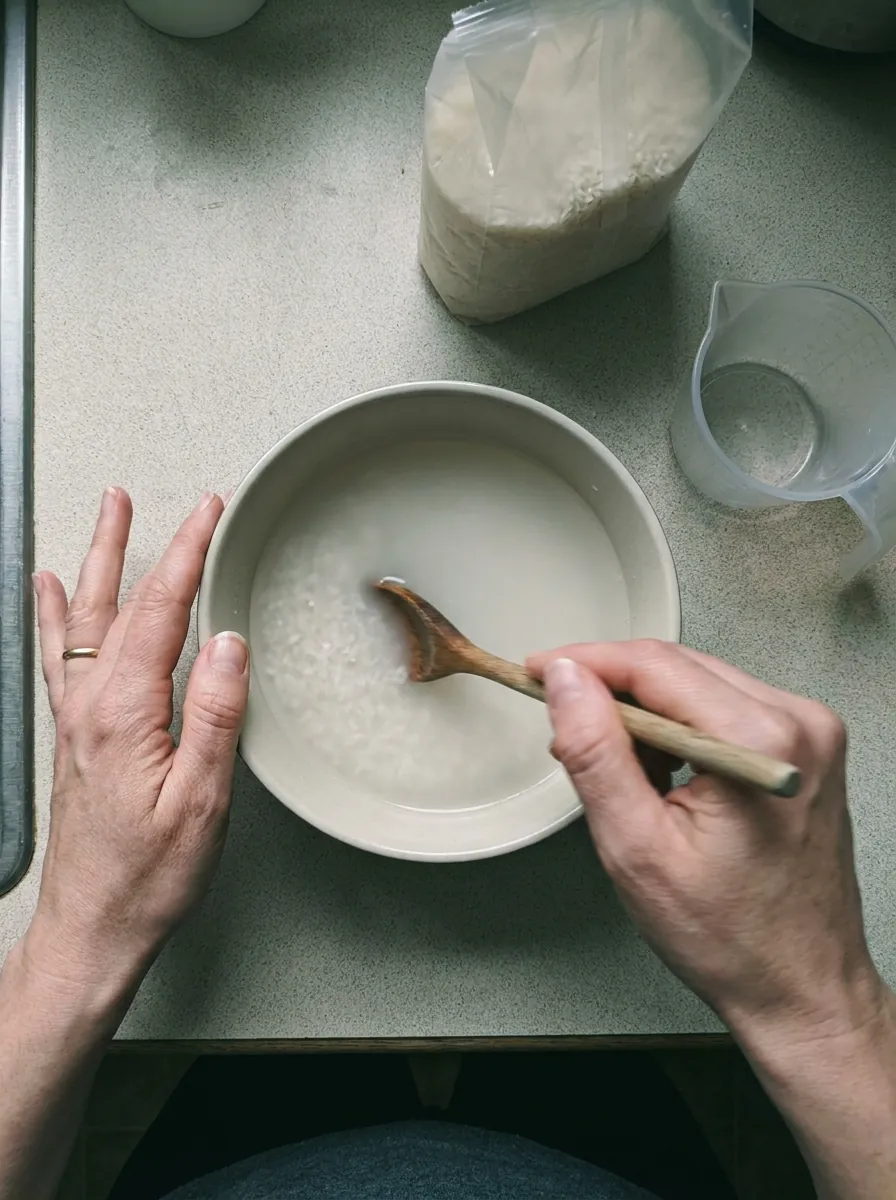
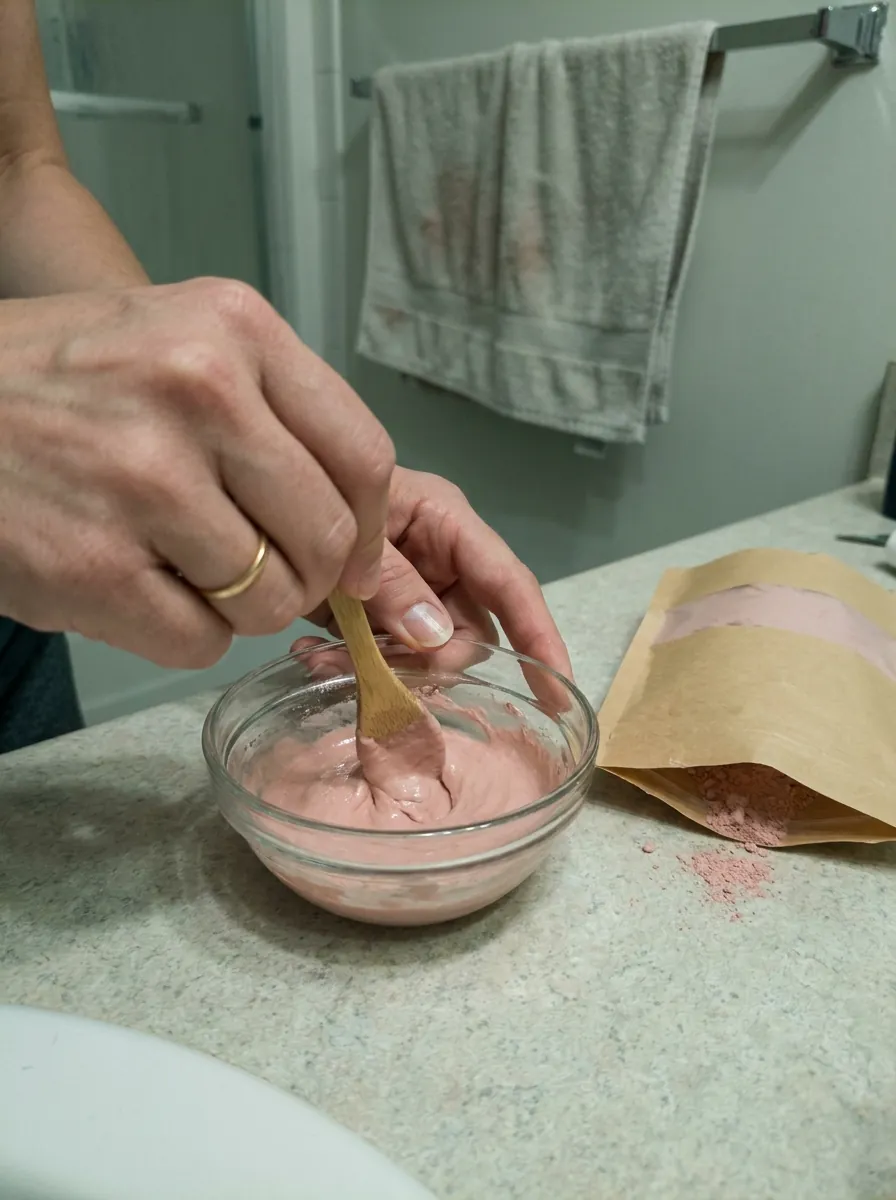
Rice. A bag of dried amla. Rosemary. That was the first basket. I had already burned $808 on things designed by people with laboratories — what was one more Sunday?
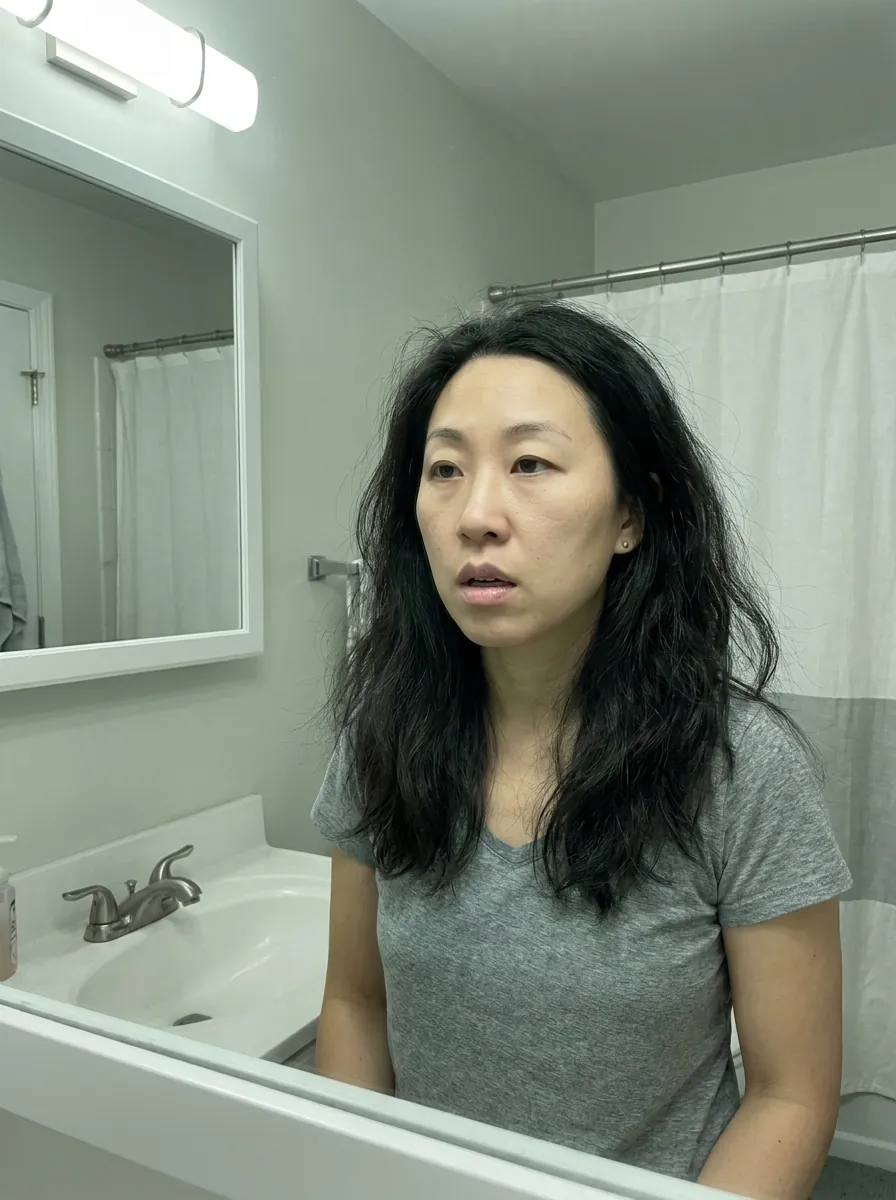

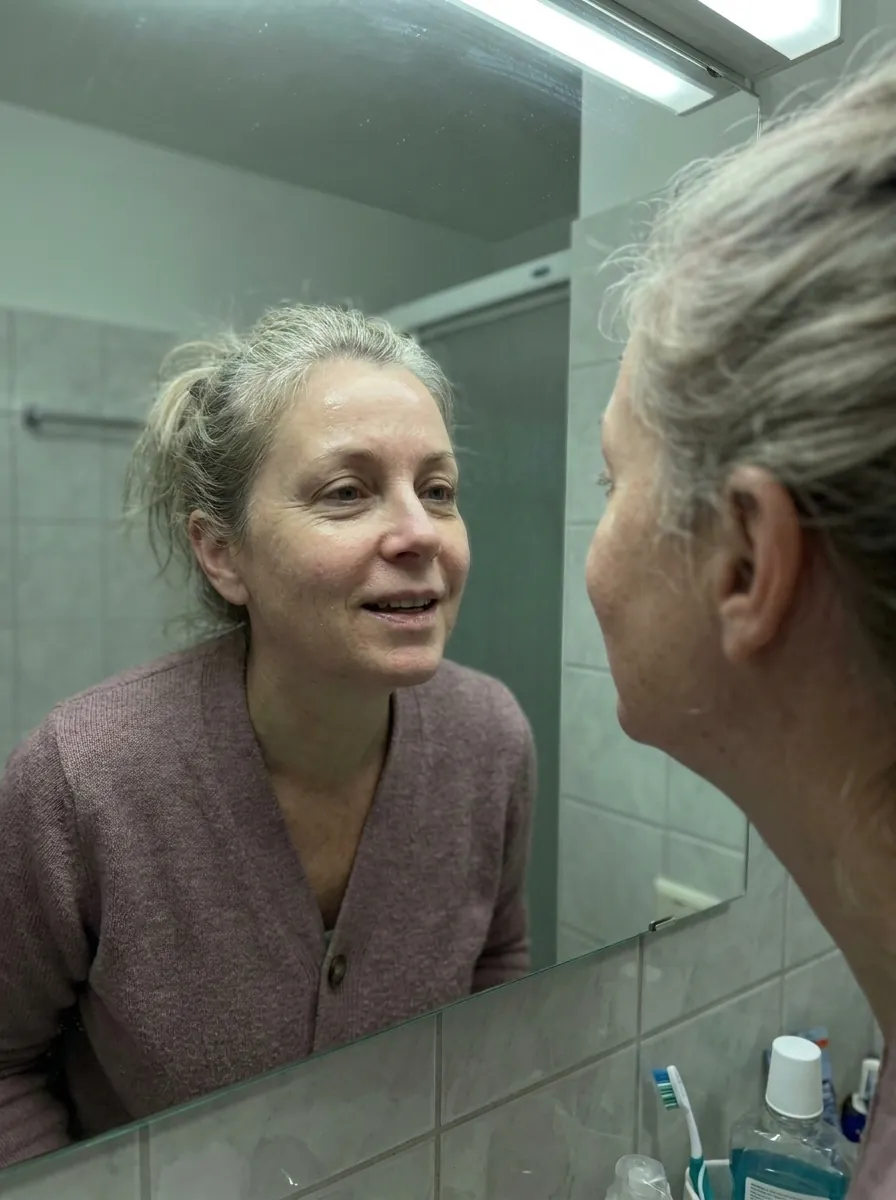
June — week 1 vs. week 6. Same bathroom, same light, same phone, no filter. Recipe #01 (fermented rice water rinse) + the amla scalp oil, twice a week.
Mixed the rice water and put the jar on the counter where I'd have to look at it. Felt ridiculous.
Nothing. I want to be honest with you, because everybody lies about this part: week one, nothing at all. I nearly quit on the Thursday. The only reason I didn't is that quitting had already cost me $808.
The drain. There was still hair on it — but I could count it. I stood in the shower counting hair off a drain cover like a crazy person, and then I sat down on the edge of the tub.
I wore it down to my daughter's recital. First time in a year and a half. I put it back up in the car afterwards out of pure habit, and caught myself doing it.
Moved my part back to the middle. Took a photo in the bathroom mirror because I didn't trust my own eyes, and compared it against one from January.
Back at the salon. Same stylist. She reached for the chair and I said it before she could turn it: "leave it facing the mirror."
She washed it, ran her hands through it, stopped — and said the sentence I had been waiting three years to hear from anybody:
"Okay. What are you using? Because whatever it is, don't change it."
Rice. And a $3 bag of dried amla.
I didn't cancel a $35,000 surgery. This isn't that kind of story. I just stopped hiding hair in my fist, and I got my own reflection back from a stranger who had been trying to protect me from it.
And then I did the thing that turned into the last two years of my life: I went and found the other fifty-one.
52 recipes, measured and sequenced — for less than one bottle of what didn't work.
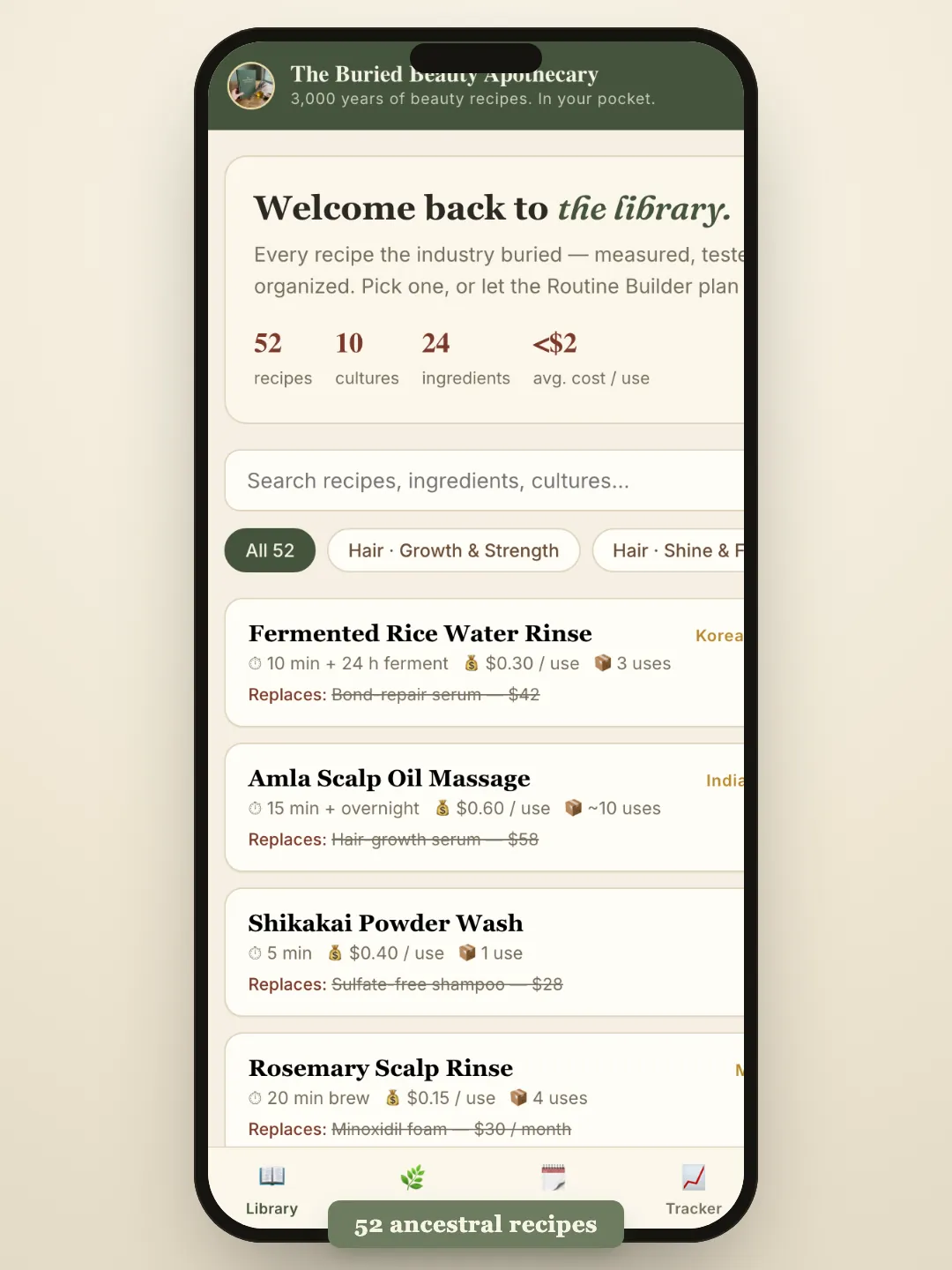
One recipe is a nice Sunday. A system is what changes your hair and your skin. The Apothecary is a pocket app — works in any browser, installs on your phone in one tap, no app store — with five tools that work together.
52 ancestral recipes by concern (hair, skin, teeth, body), ingredient, culture and prep time. Each with exact measurements, step-by-step, results timeline, precautions — and which modern product it replaces, with that product's price.
24 ingredients — every oil, clay, herb and water: what it does, who it's for, how to store it so it doesn't go off, and where to buy it. Most are under $10.
This is the "sequenced" part. Tell it your concerns — "fine hair + dry skin + 40s" — and it lays out the week so nothing cancels anything else out.
A photo and a note per week, in the same light, so you're not arguing with your own memory at week three. Your photos stay on your phone.
Built automatically from the recipes you pick. The starter kit is 7 ingredients, under $30 total, and it covers dozens of recipes.
The moment you check out you download the PDF, so nothing waits for "when I have time":
This isn't one tradition repackaged. It's what's left of ten of them, written down before the last women who remember them are gone — which is not a marketing line. It is the actual reason I started.
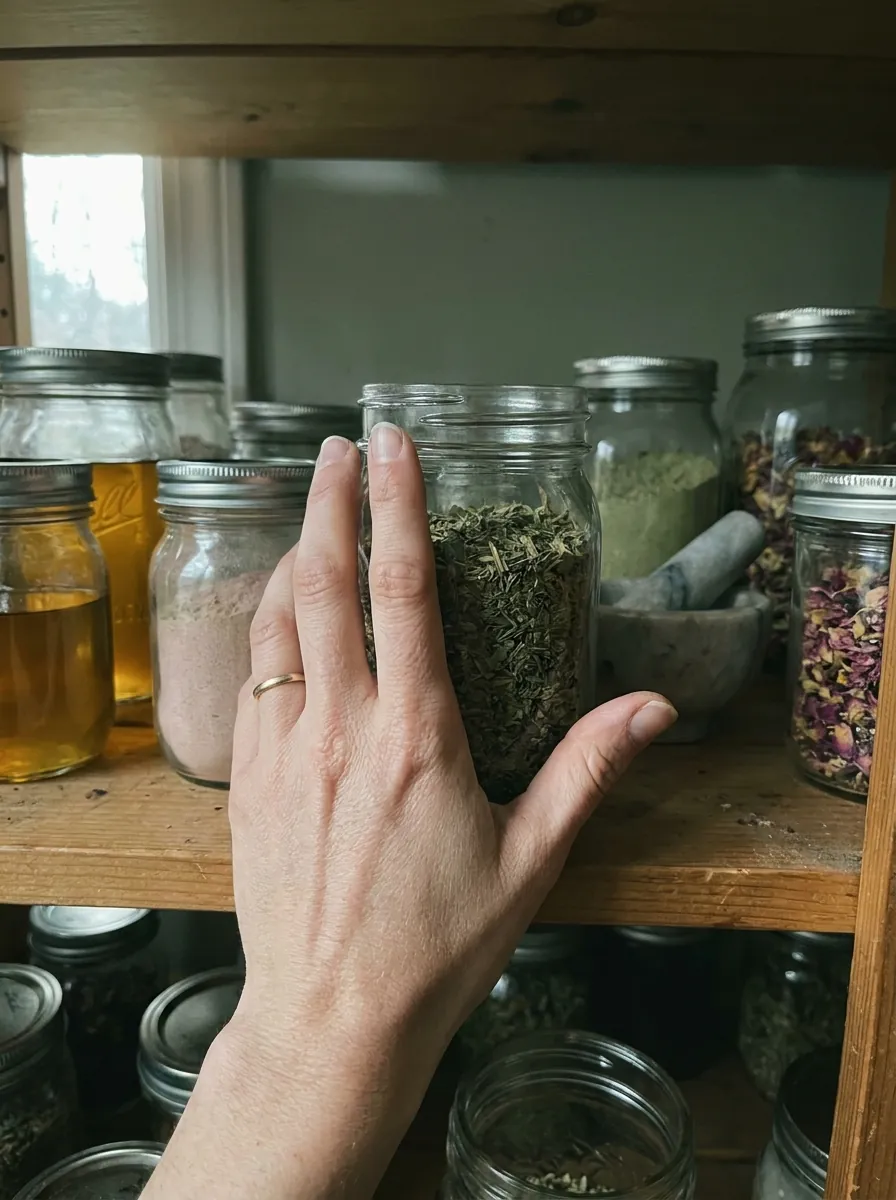
I picked these on purpose. Each one is an objection I hear constantly, answered by somebody who had it.

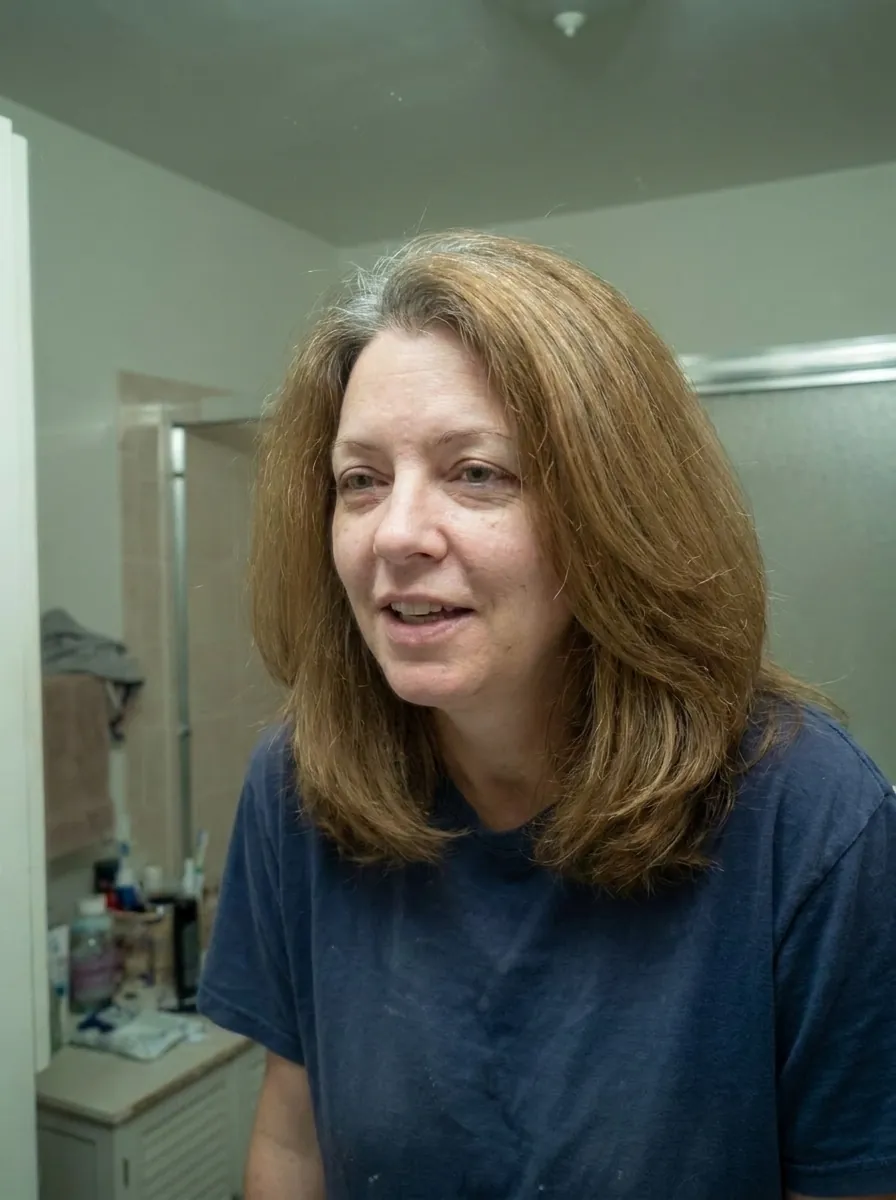
Rice water rinse + amla scalp oil, twice a week. "I assumed this was a thing for 25-year-olds who already had good hair."
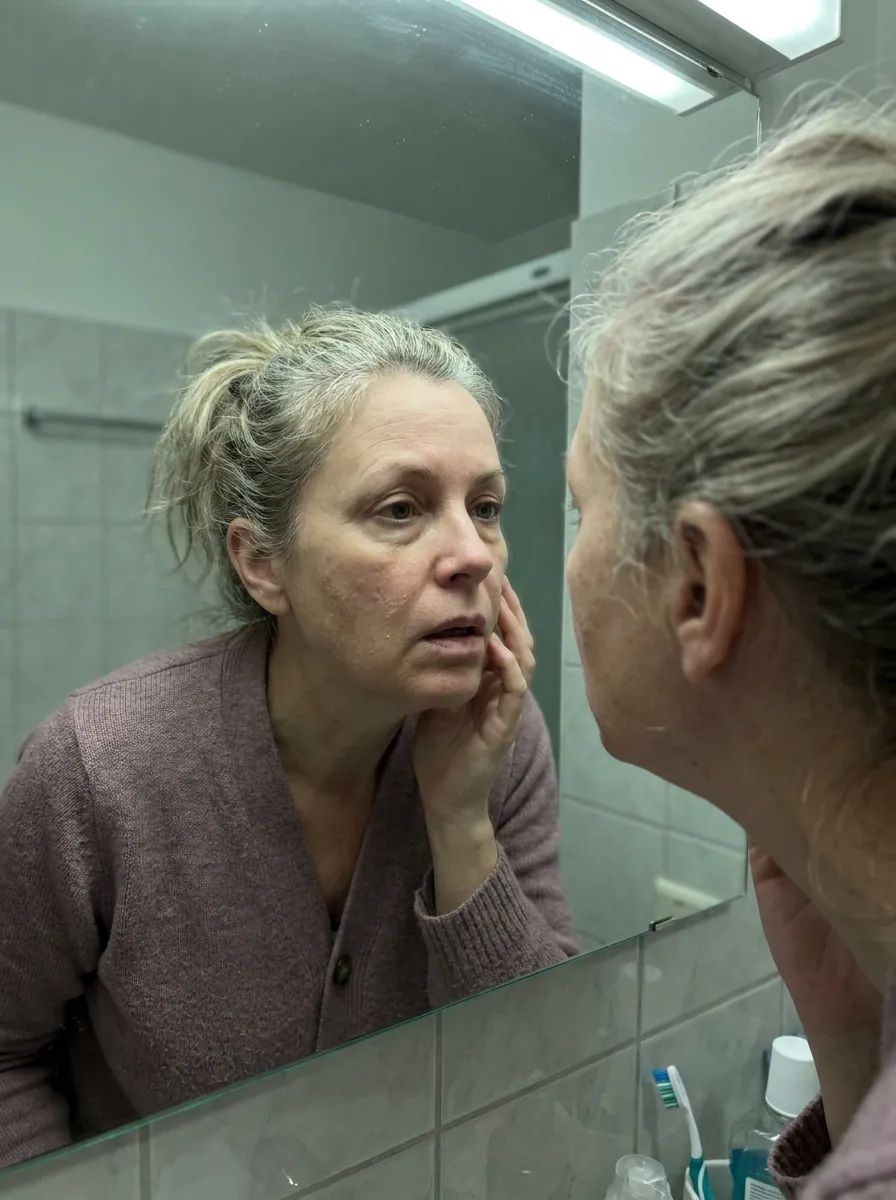
Pink clay + honey cleanse, twice a week. "Half the library is skin. I had no idea until I opened it."


Persian sugar wax, weekly — three ingredients, all of them already in your kitchen. Finer regrowth by week 8.
← swipe to see all three →
"I made a clay mask off a blog two years ago and it burned. Turns out the blog never gave a ratio, and dry clay on skin is the whole mistake. The app says 1:1 and says never let it crack. Same clay. Completely different Sunday."
— Dana, 41 · Ohio
"I do one thing on Sunday night that takes eleven minutes, and then it lives in a jar in the fridge for the week. It's less work than the five-step routine I was already not doing."
— Priya, 36 · Texas
"I'm a nurse. I came in ready to be annoyed by this. What actually sold me was the precautions section — it tells you when a recipe is photosensitizing, and when not to do something at all. It says 'go see someone' more than once. That is not what I expected."
— Ellen, 52 · Pennsylvania
"Four stars because I wish the shopping list let me tick off what I already own. But the starter kit really was under $30, and I've now done nine different recipes out of those seven ingredients."
— Robin, 49 · Oregon
A price on its own doesn't mean anything. It only means something next to what you would otherwise spend — so let me put my own list back on the table, because that's the honest comparison:
That's the whole argument. $27.90 is less than one bottle of the serum that didn't work — and the serum runs out in six weeks, while a library doesn't run out at all.
And it isn't money for me the way a bottle is money for a brand. There's no refill. Nothing arrives every month. You buy it once, it's yours, and if it works you never pay me again — which is a terrible business model and exactly the one these recipes deserve.
I document these in batches, with the women who still remember them. Batch #1 — the 52 recipes in the library today — was funded by the channel. The $27.90 founding price funds batch #2, and it closes when batch #1 finishes mirroring into the app. After that The Apothecary goes to its regular $39.97.
There's no fake counter on this page and no "only 7 left" — it's a digital library and I'm not going to insult you. But the cost of waiting is real anyway, and it's two things:
Every week you wait is another week of $40 bottles doing the thing bottles do. And the women who still remember these recipes are in their eighties and nineties. That clock isn't a marketing device. It's the only reason this project exists at all.
Regular price $39.97 · nothing recurring · yours forever
Get it tonight. Do the 7-Day Reset. Make the rice water, mix the clay, warm the oil — actually use it, for a full month.
If your own mirror disagrees with me, email me inside 30 days and you get every cent back. No form, no exit interview, no hard feelings — and you keep the Quick-Start Guide, because you did the work.
Which means the only thing left to decide is whether you'd rather find out, or keep wondering. The recipes have survived three thousand years. They'll survive your skepticism.
The eleven bottles stay on the shelf. You buy the twelfth in about five weeks, because the eleventh will have gone flat by then and there will be a new one with a better dropper.
You keep the claw clips. You keep asking people to delete the photograph.
And a year from now you're at the same shelf, four hundred dollars lighter, having a conversation with yourself about your age.
Nothing changes if nothing changes.
You download the Quick-Start Guide in about ten seconds, spend $8 at the grocery store tomorrow, and mix something in a bowl on Sunday.
Week one you feel ridiculous and nothing happens. I've already told you that part.
Week six, you count the drain. And at some point you tell somebody to leave the chair facing the mirror.
And if not — full refund. Your risk is zero.
Both, and they do different jobs. The Apothecary is a web app (PWA): it works in any browser and installs on your phone's home screen in one tap — no app store, no account to manage. The Quick-Start Guide is a PDF you download the second you check out, so you can start tonight instead of "when I have time".
Fair question, and I'd rather you ask it out loud than quietly assume something is wrong. The catch is that there's no warehouse. No bottles, no truck, no preservative system, no retail markup, and no refill to sell you next month. What you're paying for is two years of tracking recipes down, testing every measurement in a home kitchen, and the app that holds them. Cheap to buy is not the same as cheap to make — and I would rather a thousand women afford it than a hundred women "invest" in it.
No. The starter kit is 7 ingredients, under $30 total, all on Amazon or in a decent grocery store — and every recipe links to exactly where to buy each one. The average recipe costs under $2 a use. Several you can make tonight with rice, honey and oil.
If you can stir a bowl, you can do every recipe in this library. Exact measurements, never "a pinch". Prep time on every recipe. The common mistakes listed out, because most "it didn't work for me" stories are one of four mistakes. And the Routine Builder tells you what to do on which day, so you're not deciding anything at 10pm.
Because it isn't her field, and I want to be careful here: she is not the villain of this page. Dermatology is trained on what's in bottles and on medicine, and for a lot of problems that is genuinely the right tool. This is beauty and hygiene — hair, skin, teeth, body — not medicine. If something needs a doctor, the app says so, by name, inside the recipe.
No, and I won't pretend otherwise. These are traditional beauty and hygiene recipes, not treatments. Every recipe carries its precautions — allergies, photosensitivity, pregnancy — and tells you when to see a professional instead of mixing something in a bowl.
Then you pay nothing. Use it for a full 30 days; if your mirror disagrees with me, one email gets you a full refund and you keep the Quick-Start Guide.
Not with a conspiracy. With a warehouse, a truck, and thirty months of shelf life — which turned out to be enough to make three thousand years of knowledge look primitive.
It isn't primitive. It's just not shippable. Those are two completely different things, and nobody ever told us.
P.S. — I still make the rinse on Sunday nights. Not because I have to any more; I'm well past the point where I need it. I do it because I am never going back to carrying my own hair to the trash in a closed fist, and eleven minutes on a Sunday is a very cheap insurance policy against that.
P.P.S. — Last month my daughter asked me to teach her the rice water one. She's fourteen and she wanted to know how long it ferments. That's the part I genuinely didn't see coming when I started: these recipes survived three thousand years for exactly one reason, which is that somebody always taught somebody. If they end with us, it won't be because they stopped working.
P.P.P.S. — And if you bookmark this for later: the founding price closes when batch #1 finishes mirroring, the page goes to $39.97, and five weeks from now there will be a twelfth bottle on the shelf. That part I can promise you.
Okay, I have to say something. I bought this at $39.97 when it first went up and now it says $27.90?? That's honestly a little annoying. (It's still the best forty dollars I've ever spent on my hair. But still.)
You're right and I'm sorry — batch #2 pricing went live last week. Email me and I'll send you the Clay Codex the moment it's finished, on the house. — J
Practical question before I buy — does this work on an Android? I don't have an iPhone and I'm not downloading anything from a store.
Android here. It's just a website you add to your home screen and then it looks like an app. One tap, and I am not a technical person.
The honest bit about week one being nothing is what made me trust the rest of it. Mine took closer to four weeks, not two — I have thicker hair and I think it just takes longer. Stick with it is my advice.
Retired pharmacy tech. I read the whole thing waiting for the part where it tells you to stop taking your medication, or that some plant cures something. It never comes. It's recipes with measurements and a list of what not to do. I owe this page an apology for the first five minutes.
Bought it for me and immediately told my mother and my sister. The thirty-month thing has genuinely ruined the drugstore for me. I stood in the aisle turning bottles around looking for that little jar symbol and now I can't unsee it.